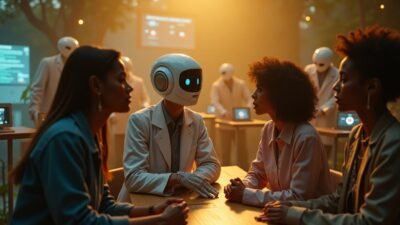


The Future of Software Development: Embracing Vibe Coding
Introduction
In today’s rapidly evolving tech landscape, the concept of Vibe Coding is gaining traction. This approach intertwines creativity with traditional code generation, sparking innovation in software development. As AI technologies become more sophisticated, they significantly influence how developers approach vibe coding, largely due to the rise of AI babysitters—experienced developers who oversee the quality of AI-generated code. This article explores the transformative role of vibe coding, highlighting the productivity benefits and challenges that developers encounter today.
Background
Vibe coding is an exciting frontier in software development. It emphasizes rapid prototyping and dynamic code generation, allowing developers to explore creative solutions quickly. However, with the increasing reliance on AI tools, these benefits come with their own set of challenges. AI tools, by design, facilitate code generation but often require human intervention to ensure precision and correctness. Enter the AI babysitters—seasoned developers whose job is to polish and refine the AI-generated outputs.
This need arises from the imperfections inherent in AI systems. Like a cook enhancing the flavor of a dish with perfect seasoning, AI babysitters scrutinize and adjust code to enhance functionality and mitigate errors. According to a Fastly survey, a staggering 95% of developers report spending additional time refining AI-generated code. This hybrid approach to coding underscores both the strengths and limitations of AI in software development \”TechCrunch\”.
Trend
The integration of AI into software development is a rising trend that cannot be overlooked. Developers increasingly validate and refine AI-generated code to maintain quality. Fastly’s data illustrates that senior developers are twice as likely as their junior counterparts to deploy AI-generated outputs directly into production, emphasizing the importance of experience in this evolving landscape [\”Fastly\”]. This pivot towards AI-assisted development is driven by several factors:
– Efficiency Gains: AI can produce code swiftly, aiding in rapid product iteration.
– Resource Allocation: Freeing developers from routine coding tasks allows them to focus on more complex challenges.
– Innovation Potential: AI can offer unique approaches that human developers might not consider initially.
However, it also implies a shift towards roles that prioritize oversight and quality assurance over just pure coding, illustrating the growing need for AI babysitters in vibe coding.
Insight
Insights from industry trends reveal a crucial shift in job roles due to the influence of AI in vibe coding. Senior developers are increasingly tasked with supervising AI-generated outputs, providing a vital layer of quality control. Carla Rover, an experienced developer, remarked on the necessity of this intervention, highlighting that AI, while beneficial, often performs tasks that require further human refinement \”TechCrunch\”.
This transformation suggests a delicate balance between leveraging AI tools for their generative capabilities and ensuring that the final output meets stringent quality standards. As Austin Spires noted, \”What often happens is the engineer needs to review the code, correct the agent, and tell the agent that they made a mistake.\” Their insights accentuate the trending affinity towards a hybrid approach in software development, championing human oversight alongside AI capabilities.
Forecast
Looking to the future, the evolution of AI technologies will undoubtedly reshape the role of developers even further. We can anticipate a surge in demand for new roles focused on quality assurance within vibe coding. The notion of AI babysitters will likely expand, with developers guiding AI systems more than they write code themselves. As the field matures, we’ll witness enhanced synergy between human insight and AI ingenuity. Key forecasts include:
– New Job Roles: The emergence of roles that specialize in AI code oversight and optimization.
– Enhanced Training: A need for training programs focusing on AI integration in software development processes.
– Ethical Guidelines: Development of ethical standards to manage AI-related risks and responsibilities effectively.
Kimara aptly stated, \”We won’t just be writing code; we’ll be guiding AI systems, taking accountability when things break.\” This future is indicative of a paradigm where human expertise and AI capabilities coalesce, promising advancements in both productivity and innovation [\”Fastly\”].
Call to Action
In conclusion, the landscape of software development is undergoing a dynamic transformation with the rise of vibe coding and the prevalence of AI babysitters. To stay ahead in this evolving field, it is imperative to keep informed about the latest trends and practices. Embrace these changes by subscribing for updates on innovative coding practices, and explore how to leverage AI tools responsibly on your software development journey. For additional insights, read the full article on TechCrunch for first-hand experiences of developers at the forefront of these changes \”TechCrunch\”.